Forestry mulching is a land clearing method that uses a single machine to grind trees, brush, vines, and overgrowth into wood chips right where they stand. No debris piles, no burn permits, no hauling trucks. The machine does the work in one pass, and the cleared land is ready to walk the same day.
Most property owners around Moncks Corner who call us have never seen a forestry mulcher work before. What they expect and what they actually see are two very different things — and that gap is worth explaining before you decide whether this service fits your property. If cost is already on your mind, we break down exactly what drives the price in our full forestry mulching guide.
The Machine Behind the Method
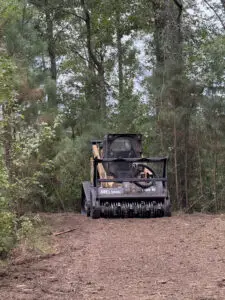
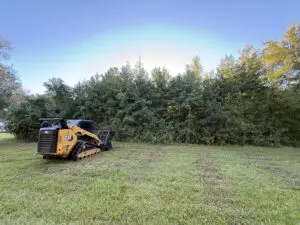
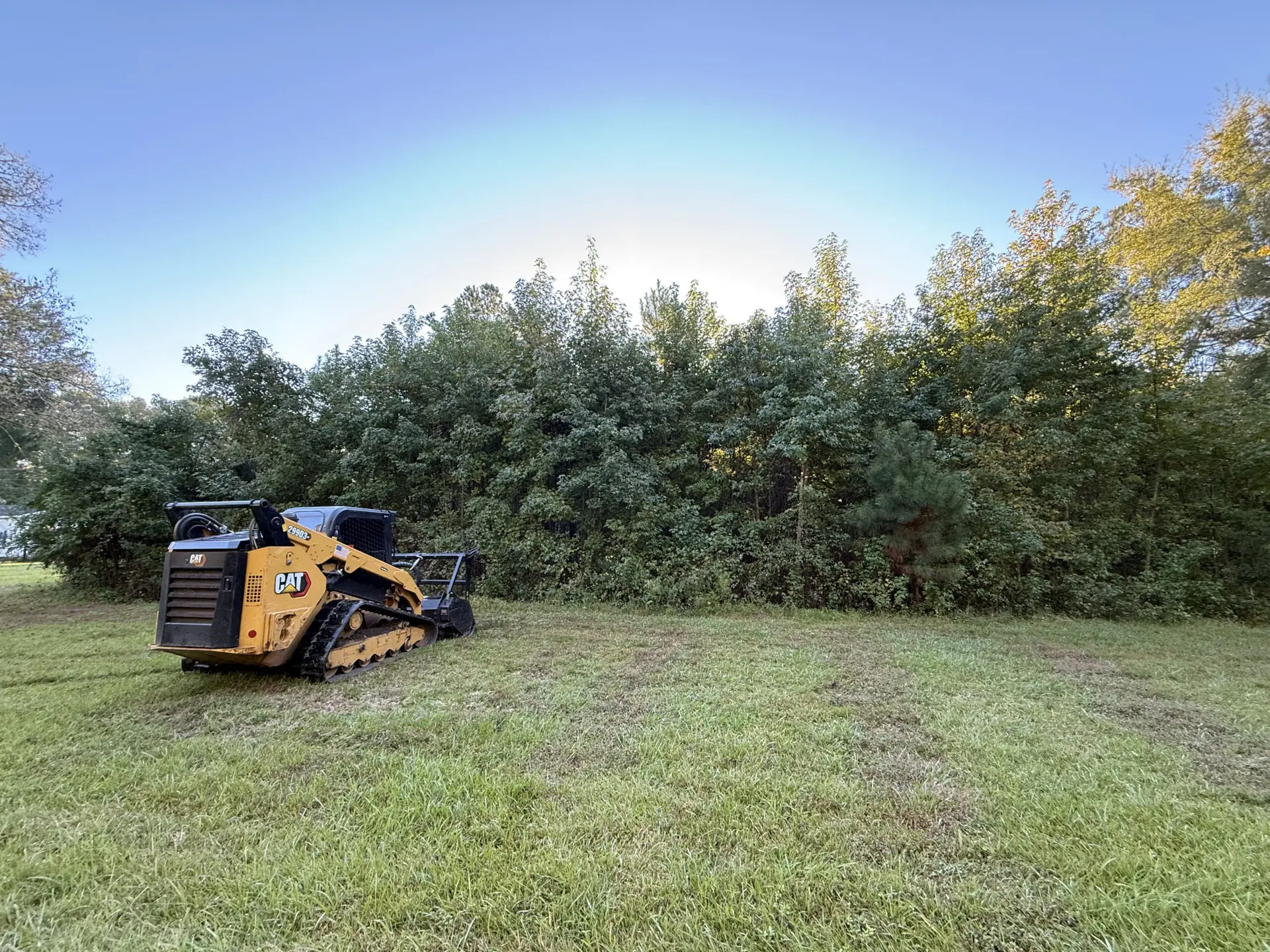
A forestry mulcher is a skid steer or tracked machine fitted with a rotating drum covered in carbide teeth. The drum spins at high speed, and as the machine drives forward, those teeth shear and grind whatever vegetation is in the path — small trees, thick shrubs, vines, briars, and brush — down to a layer of wood chip mulch on the ground.
The key phrase is “in one pass.” The machine doesn’t cut and then come back to haul. It doesn’t pile debris for you to deal with later. It processes the vegetation on the spot, and the mulch stays where it lands.
Did You Know? Forestry mulchers are sometimes called masticators or brush mulchers. The USDA’s Natural Resources Conservation Service has documented mulchers on forestry projects because the mulcher is by far the most efficient option for processing standing trees and downed material in a single pass — the same reason Lowcountry residential jobs get done in a day rather than a week.
What Kinds of Vegetation It Handles
The drum can process small to medium-sized trees — typically up to six to eight inches in diameter at the base — plus any amount of shrubs, vines, and dense brush. The species we deal with most around the Lowcountry include privet, sweetgum saplings, Chinese wisteria, wild briars, and various native scrub. All of it goes through the drum cleanly on a single pass.
Larger specimen trees — the kind with significant canopy that you want to keep — are worked around carefully. We walk the property with you before the machine starts specifically to flag anything that should be preserved.
What’s Left Behind
After a forestry mulching job, the ground is covered in a two-to-four-inch mat of wood chips. This is not a mess. That mulch layer protects bare soil from rain erosion, retains moisture, and breaks down into organic matter over several months. On the sandy-loam soils common across Berkeley County, this is actually a benefit rather than a neutral outcome.
Pro Tip: If you plan to seed grass or start landscaping after the mulching is done, ask about leaving a thinner mulch layer in those specific areas. A light covering protects the soil; too deep a layer can slow new grass from establishing.
Why Property Owners Are Surprised the First Time They See It
Here’s what we see play out regularly: a property owner calls because their half-acre has grown up with privet and vines spreading for three or four years. They’ve gotten quotes for traditional clearing — a crew, a chipper, a dump trailer or two, maybe a burn pile if restrictions allow it.
Then they watch our skid steer work through that same half-acre in an afternoon. No trailer. No pile. Nothing to come back and deal with. Just cleared land with a layer of wood chips where the tangle used to be.
The surprise is real every time. Forestry mulching collapses what used to be a multi-day, multi-step job into a single machine visit. That efficiency is the core of what the method is.
What Forestry Mulching Is Not
It’s worth being clear on what this service doesn’t do, because the name causes confusion.
Forestry mulching is not the same as spreading decorative mulch around flower beds. The mulch it produces is a natural byproduct left on the ground, not a landscaping material you apply to something.
It’s also not the same as full land clearing, which typically involves removing vegetation, grading, and hauling material away to leave a completely bare lot. If you need a bare, graded surface for a construction project, that’s a different scope of work — and worth discussing before you decide which service you’re calling about.
And it’s not underbrush clearing, which selectively removes the lower layer of shrubs and vines while leaving your mature trees fully intact. Underbrush clearing is the right call when you want to keep your tree canopy and just clean out what’s growing underneath.
Forestry mulching handles everything in the target area — small trees included. When you want overgrown land cleared fast, without a debris staging problem, that’s where it fits.
Question: Is forestry mulching the same as land clearing? Answer: They’re related but not the same. Forestry mulching processes vegetation in-place using a single machine, leaving a mulch layer behind. Traditional land clearing removes vegetation and hauls it away, often leaving a fully bare lot. The right choice depends on what your property needs after the job is done.
When Forestry Mulching Makes Sense for Your Property
This method is the strongest fit for a specific kind of job: a residential lot, typically under an acre, where the goal is to clear overgrowth fast without generating a debris disposal problem. Properties that have been neglected for a few seasons and are now thick with scrub trees and invasive vines are the ideal application.
It’s also a good first step before lot clearing work or other site preparation, since it handles vegetation quickly and leaves the ground in better condition than traditional methods that strip the topsoil.
Properties over an acre, or those with dense stands of larger timber, often need a different approach — or a combination of methods. That’s a conversation worth having during the estimate, since the wrong method on the wrong property wastes time and money for everyone.
Did You Know? Most residential forestry mulching jobs around Moncks Corner are completed in a single day. The compactness of the work is what makes it so cost-effective for smaller overgrown lots compared to multi-day traditional clearing jobs.
Lowcountry-Specific Considerations
The South Carolina Lowcountry has a specific vegetation problem that makes forestry mulching particularly useful here. Berkeley County’s warm, humid climate and high rainfall mean that invasive plants like Chinese wisteria, privet, and kudzu can reclaim cleared land faster than in drier regions. A property that was manageable three years ago can be an impassable thicket today.
The Clemson Cooperative Extension’s Forestry & Wildlife Resources program offers research-based guidance on vegetation management specific to South Carolina landowners — worth reading if you’re making longer-term decisions about your land.
The single-pass efficiency of forestry mulching lines up well with properties where vegetation regrowth is a persistent challenge. Getting the land cleared without a debris pile sitting around for weeks gives you a cleaner starting point for whatever comes next.
Frequently Asked Questions
What is forestry mulching used for? Forestry mulching is used to clear overgrown residential lots, reclaim neglected acreage, and prepare land for fencing, landscaping, or other improvements. It works by grinding vegetation into mulch in one pass, leaving the ground clear without any debris to haul away.
Does forestry mulching kill the roots of cleared vegetation? The mulcher processes vegetation above the ground surface and does not dig out root systems. Most cleared plants will not regrow vigorously from the remaining roots, but some aggressive species like privet may require follow-up treatment if regrowth appears in subsequent seasons.
How is forestry mulching different from brush cutting? Brush cutting typically mows or cuts vegetation but leaves material on the ground in a less processed form. Forestry mulching grinds everything into fine wood chips, producing a cleaner result and eliminating the bulk of what was cut. For heavy woody vegetation, mulching handles material that a brush cutter can’t.
Can forestry mulching be done near trees I want to keep? Yes. Operators can work carefully around specific trees you want preserved. Walking the property before the job starts and marking any trees you want kept is the best way to make sure the machine stays clear of them.
How long does a forestry mulching job take on a typical Lowcountry lot? Most residential lots under an acre in the Moncks Corner area are completed in a single day. Denser or wetter lots may take longer, which your estimate will account for upfront.
If your property has grown past the point where you can manage it yourself, forestry mulching is likely the fastest path back to usable land. For a more detailed look at what the service covers and how we price it, read our complete guide to forestry mulching — or reach out directly for a free, no-obligation estimate. We serve Moncks Corner and the surrounding Lowcountry Monday through Saturday, 7 a.m. to 7 p.m.