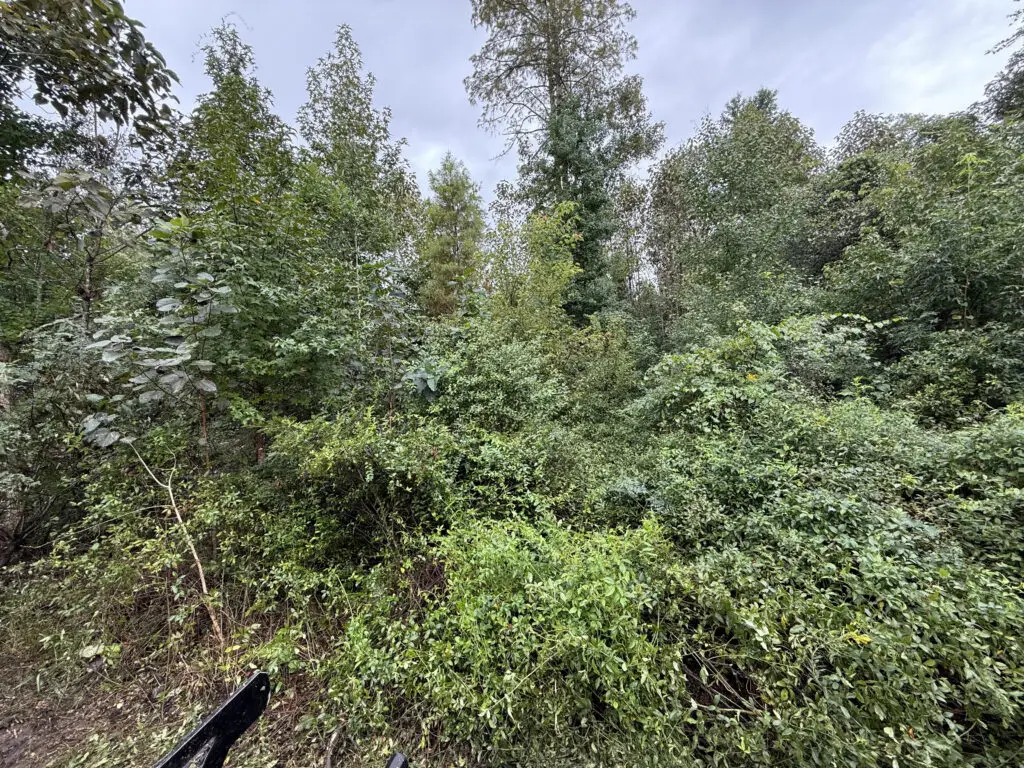
In the South Carolina Lowcountry, a wooded property does not stay open on its own. Berkeley County’s warm, humid climate turns a manageable woodland into a dense, impenetrable tangle of privet, wisteria, sweetgum sprouts, and thorny vines within a couple of growing seasons. Underbrush clearing targets that ground-level and mid-level layer of unwanted growth — the stuff filling in beneath your trees — while leaving the mature timber you want to keep standing. Live Oak Property Services provides underbrush clearing for residential landowners throughout Moncks Corner, Bonneau, St. Stephen, and the surrounding Lowcountry. If your wooded lot has become inaccessible, your yard has been taken over by invasive growth, or you want to restore visibility and usability to your land without removing all the trees, we can help. Call 854-444-0672 for a free estimate.
What Underbrush Clearing Actually Involves
Underbrush is the layer of vegetation growing beneath the tree canopy — the shrubs, vines, briars, and small volunteer trees that fill in at ground level and mid-canopy height. In Berkeley County, the most common culprits include Chinese privet (one of the most aggressively invasive shrubs in the Southeast), Chinese and Japanese wisteria, greenbriar, sweetgum and water oak volunteers, and stands of native shrubs that have grown far beyond their welcome. Left unchecked, this layer creates properties that are not just unattractive but genuinely unusable — difficult to walk through, invisible from any road, and increasingly prone to harbouring snakes, ticks, and other pests. Underbrush clearing uses our skid steer with mulcher attachment to systematically process all targeted growth at ground and mid-level heights, leaving established trees and any vegetation you specifically want to preserve standing in place. The result is a wooded property that feels open, usable, and distinctly like yours again — the forest canopy overhead, the ground you can actually walk across.
Our Underbrush Clearing Process
Step 1 — Walkthrough and Identification. We walk the property with you before starting any work. This is where you identify the trees, shrubs, or specific features you want to keep, and where we assess the density, species composition, and extent of the underbrush. In Lowcountry properties near water features like Biggin Creek or properties adjacent to Lake Moultrie’s wetland fringes, we also note any drainage patterns or wet areas that require careful equipment routing.
Step 2 — Boundary and Preservation Marking. Any trees, shrubs, or plant groupings that are to be preserved are clearly noted before the machine starts. We use this walkthrough to establish a shared understanding of what stays and what goes — eliminating any ambiguity that could lead to unintended removal once the machine is moving.
Step 3 — Systematic Underbrush Removal. The skid steer with mulcher attachment works through the clearing zone in methodical passes, processing all targeted underbrush — privet stands, vine tangles, woody shrubs, small volunteer trees — at ground level. The mulcher grinds material in-place, leaving a layer of natural wood chip mulch that decomposes over time and reduces the reseeding of invasive species.
Step 4 — Edge and Tight-Area Cleanup. Along fence lines, near outbuildings, and in areas where the machine cannot reach full speed, we work slowly to ensure complete coverage without damage to structures. Fence lines along Lowcountry properties frequently accumulate some of the densest growth — wisteria and greenbriar in particular — and we address these zones specifically.
Step 5 — Final Review. We walk the completed work with you before leaving. The established trees are standing. The underbrush is gone. The property floor is covered with a natural mulch layer that reduces immediate regrowth. Your land is accessible, open, and ready for whatever you planned to do with it next.
Serving Moncks Corner and Surrounding Communities
Live Oak Property Services provides underbrush clearing throughout the Berkeley County Lowcountry, including Moncks Corner, Bonneau, Pinopolis, St. Stephen, Cross, Santee, Holly Hill, Ridgeville, Harleyville, St. George, Awendaw, and Johns Island. We understand that Berkeley County’s vegetation is not the same everywhere — properties near Cypress Gardens and the Back River have a different understory profile than drier lots along Highway 17A near Carnes Crossroads, and we approach each accordingly. Visit our home page to see our full service map and coverage area.
Why Moncks Corner Homeowners Choose Live Oak for Underbrush Clearing
We are locally based and owner-operated, which means we are not guessing at what Berkeley County vegetation looks like. Chinese privet grows differently than sweetgum volunteers. Greenbriar requires a different pass speed than open scrub brush. We bring that specific knowledge to every underbrush job we take on — and we are available to talk through your property’s particular situation before we ever show up with equipment.
Every job we take on gets a free estimate and a flat-rate quote before any work starts. We show up on the scheduled day, we do the work we committed to, and we do not leave a job unfinished. Learn more about our team and approach.
Chinese privet and wisteria are two of the most stubborn invasives we encounter in Berkeley County. Both require removal at the root collar to prevent regrowth — cutting above ground just delays the problem. Forestry mulching at ground level targets exactly that, which is why it’s our primary recommendation for properties with heavy invasive pressure.
Frequently Asked Questions: Underbrush Clearing in Moncks Corner
How is underbrush clearing different from land clearing?
Land clearing removes everything in an area — trees, stumps, and all vegetation — to bring ground to bare soil. Underbrush clearing removes only the ground-level and mid-level growth while leaving established trees standing. If you want to open up a wooded property without taking down the mature tree canopy, underbrush clearing is the right service.
Will you be able to work around the tree I want to keep?
Yes. The pre-work walkthrough exists specifically for this. We note every tree or plant grouping you want preserved before the machine moves. The skid steer’s mulcher can be controlled precisely enough to work within a few feet of a tree trunk without damage to the bark or root flare, though we always confirm this with you during the walkthrough for any tree you are particularly concerned about.
How quickly does underbrush grow back in Berkeley County?
In the South Carolina Lowcountry, regrowth is aggressive — especially for invasive species like Chinese privet, which resprouts from the root collar if not fully processed, and wisteria, which can regenerate from any root fragment left in the soil. A thorough underbrush clearing done with a mulcher addresses most of this by grinding material at ground level. Some customers schedule periodic maintenance clearing — typically once every one to two growing seasons — to keep invasive regrowth from re-establishing.
Can underbrush clearing help with tick and snake control on my property?
Reducing dense underbrush eliminates the habitat conditions that ticks, snakes, and other pests prefer — tall grass, dense shrubs, and leaf litter accumulation. While underbrush clearing is not a pest control service, it is commonly cited by landowners as one of the most effective steps they take to make their wooded properties more comfortable and safer to use, particularly in the Berkeley County area where deer ticks are common.
Do you clear near fence lines and structures?
Yes. We address fence lines, outbuilding perimeters, and other tight areas during the edge cleanup phase of every job. Let us know during the estimate walkthrough if there are specific areas of concern, and we will plan our approach accordingly.
Ready to restore your wooded property? Call 854-444-0672 or submit a request through our contact page. Free estimates, Monday through Saturday, 7 a.m. to 7 p.m.